
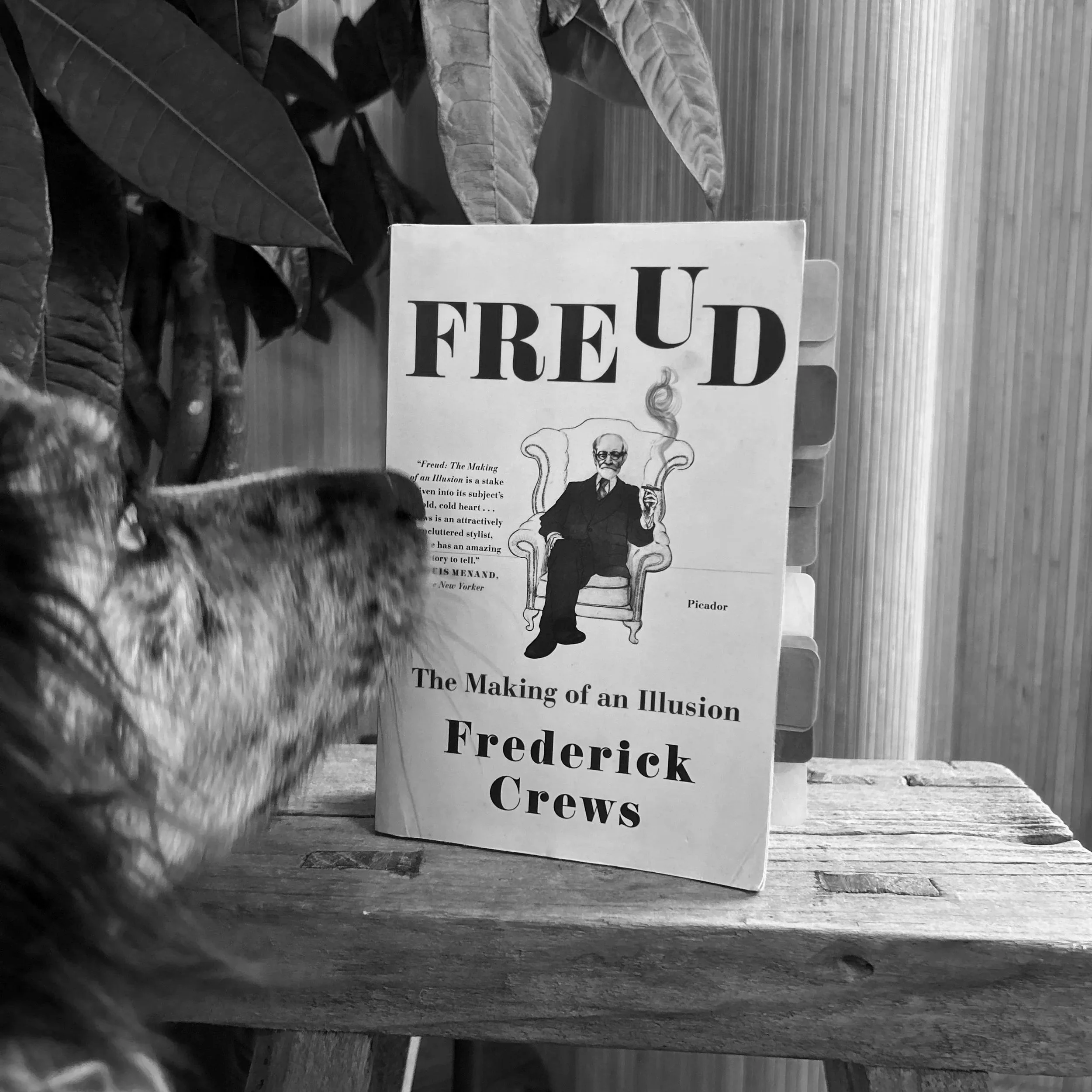

The Heart of It
Freud is often referred to as the “father of modern psychology.” Indeed, few figures are so influential as to have had their names and concepts thoroughly engrained into modern parlance— think freudian slip, oedipal complex, ego, projection. All terms that come from Freud.
One would think, then, that he was a trustworthy scientist who made recommendations based on clinical observation and the best theories and tools available to him at the time. I can not understate just how incorrect that assumption is, and indeed, Frederick Crews wrote almost 700 pages on the subject. Seven hundred pages dismantling not only Freud’s professional credibility, but his character.
While this might not be a book that has inherently clinical content, it’s a piece that invites us to think more deeply about the theories of mind that inform Western psychology, the institutions and people that advanced those ideas, and the implications for modern practice. If you’re interested in that, you’ll find this riveting.
Quotes that Inspire
“I am actually not at all a man of science, not an observer, not an experimenter, nor a thinker. I am by temperament nothing but a conquistador— an adventurer, if you want it translated— with all the curiosity, daring, and tenacity characteristic of a man of this sort.” - Freud in a letter to Wilhelm Fleiss, 1900
“So yesterday I gave my lecture. Despite a lack of preparation, I spoke quite well and without any hesitation, which I ascribe to the cocaine I had taken beforehand. I told about my discoveries in brain anatomy, all very difficult things that the audience certainly didn’t understand, but all that matters is that they get the impression that I understand it…” - Freud in a letter to his wife Martha, May 18, 1884
Key Takeaways
Freud was not well-respected by many of his contemporaries
Partially this was a matter of temperament, as Freud was a cocaine addict with a nasty temper who was known for fierce disagreements with colleagues who slighted him. In general his interpersonal life was full of unsavory encounters— to attempting to treat a colleague with heroin addiction with cocaine (despite all evidence of its addictiveness), to having a long-term affair with his wife’s sister, to performing psychoanalysis on his own daughter and inquiring with detail about her sexual life.
Theoretically one can have an unsavory attitude and still produce sound research. But even his dear friend and collaborator Willhelm Fleiss noted that Freud was “reading his own thoughts into the minds of his patients and thus projecting his personality into his theories,” while Richard von Krafft-Ebing dismissed some of Freud’s views as “scientific fairy tale.” Pierre Janet, another scientific heavyweight of that time, went so far as to accuse Freud of plagiarism. Indeed, Freud’s work seems to be a mix of co-opted ideas mixed in with his own fantastical interpretations of clinical realities.
Freud did not appear to help patients
Freud’s relationships with his most famous patients were, by all standards, quite ridiculous. There was the case of Ilona Weiss, who had a physical disability that developed while caring for her ailing father. The woman had had a suitor previously, but the engagement was broken off. Somehow in the course of analysis this turned into Freud presuming the woman had a forbidden attraction to her brother-in-law, which had become so severe it had manifested as her physical disability. Breaking confidentiality, he wrote about this in a letter to the patient’s mother— causing even more tension to develop between them. Care was ultimately terminated, which, rather than causing Freud to question his views and methods, actually reinforced his point of view. Psychological resistance to his ideas on the part of his patients meant there was an unconscious desire to repress those views. Thus, his logic was circular.
This perhaps wouldn’t be so concerning if it weren’t for the fact that such cases were used to write the long-winded essays that would gain Freud a following and cement him as a heavyweight in the world of psychology. All while he was manufacturing conclusions and, in some cases, simply borrowing ideas from patients themselves.
Such was the case with Anna von Lieben, a patient who would conclude her five years with Freud with the observation that Freud was interested in enriching himself, rather than helping his patients. In their time together Freud would supply her drugs, despite her being an addict, and spend time pontificating about dreams (Anna’s uncle was a dream analyst), the importance of free association, and the impact of a lack of sexual fulfillment on a woman’s psyche. These ideas were passionately espoused by von Lieben, rather than Freud, and would later become the foundations of Freud’s psychoanalysis. Other patients, such as Emma Eckstein, would go on to become psychoanalysts themselves, despite having no training other than having been a patient of Freud’s.
Fun Fact
The Oedipal Complex was likely rooted in Freud’s own issues. In October 1897 he wrote to his confidant Wilhelm Fleiss:
“I have found, in my own case too, [the phenomenon of] being in love with my mother and jealous of my father, and I now consider it a universal event in early childhood…”
Perhaps it was Freud himself who needed a psychoanalyst.
My Thoughts
Typically I’m not a big biography reader, and when I purchased this book I had no idea about the length. When it came in the mail, I found myself going… Yikes. And yet, I devoured it (notice how many tabs are in the top photo). For weeks, I pondered: how did this man come to be so popular? It sent me down a rabbit hole during which I read Freud himself. And I realized that not only is what I was taught at the graduate level a deeply sanitized version of Freud, but that the man himself sounded more like a new-age guru selling tickets to his cult workshop than a seasoned researcher. And I don’t make that comparison lightly.
Overall this is a super interesting read if you like biographies and are interested in the history of psychology. My only criticism would be that the information is organized in a way that didn’t totally click, at least for me. I believe it’s chronological in nature, but from someone interested in Freud as a figurehead in psychology, rather than simply as a figure himself, I’d have preferred the content to be laid out thematically. That’s a preference, not necessarily a criticism.
Regardless, this book was an impressive undertaking. It’s a uniquely honest insight into a deeply flawed man and naturally leads us to ask questions about whether his presumptions about the mind and human nature— presumptions which still color clinical practice today— are really worth holding as truth.